

EMDR therapy for trauma and PTSD
EMDR, or Eye Movement Desensitization and Reprocessing, is a therapeutic approach to mental health that facilitates overcoming difficulties resulting from the impact of traumatic life experiences.
EMDR, or Eye Movement Desensitization and Reprocessing, is a therapeutic technique designed to aid in the recovery from panic attacks, trauma, and distressing memories. This approach utilizes rapid eye movements and your perceptions to reprocess and transform your thoughts about traumatic events, aiming for desensitization to the lingering effects of past trauma.
Although the exact mechanism of EMDR’s effectiveness remains unclear, numerous controlled trials and research studies have consistently demonstrated its efficacy.
What issues can EMDR treat?
EMDR is often used to treat:
Post-traumatic stress disorder (PTSD) and other trauma disorders
Anxiety — including panic attacks, social anxiety, obsessive-compulsive disorder (OCD), and phobias
Dissociative disorders
Eating disorders, encompassing anorexia, bulimia, and binge eating
Hoarding
Personality disorders, such as borderline personality, avoidant personality, and antisocial personality disorders
EMDR has been shown to be particularly effective in the treatment of trauma and post-traumatic stress disorder (PTSD). EMDR’s unique methodology, incorporating rapid eye movements and perceptual shifts, has demonstrated significant success in addressing the profound impact of traumatic experiences. Studies indicate that individuals struggling with PTSD or trauma-related disorders often find relief through EMDR, experiencing positive transformations in their cognitive and emotional responses to distressing or traumatic memories. By providing a focused and efficient healing process, EMDR helps individuals become desensitized to the lingering impacts of trauma.
What happens in EMDR
What you can hope to gain in EMDR
What are the upsides and downsides of EMDR?

Key Points
Research has demonstrated the efficacy of EMDR in addressing and dealing with traumatic experiences.
EMDR therapy tends to be less taxing than alternative therapeutic approaches.
Certain instances may lead to the relatively swift realization of tangible benefits.
Typically, a single traumatic event can be processed within 3-6 sessions, while more intricate trauma usually necessitates 8-12 sessions.
Research indicates that EMDR therapy has proven effective for individuals who did not experience success with traditional talk therapy, enabling them to make significant progress.
Overview of EMDR
EMDR for trauma and PTSD
Typically, EMDR treatment begins with a comprehensive history-taking. This serves both the bring clarity to the underlying causes of your struggles but also allows for the creation of a tailored plan to create strategies that you will be able to use to manage distressing memories if they should resurface.
During an EMDR session, you’ll be led through a process that involves utilizing your body and mind to reshape distressing memories. The sessions focus on targeting and processing a specific memory or event through EMDR therapy procedures.
You will be prompted to evoke a visual image linked to the memory, identify negative beliefs associated with it, and recognize the related emotions and body sensations.
As you concentrate on the challenging memory, your therapist will guide you in a sequence of side-to-side eye movements, sounds, or taps, directing you to observe the thoughts that arise after each set. This process may lead to new insights into the event or alterations in your perceptions of it, including associated images, feelings, or beliefs.
In successful EMDR sessions, the significance of distressing events undergoes a profound emotional transformation.
Certain sounds, smells, or sights can serve as triggers, suddenly bringing back memories of past trauma. When your brain involuntarily recalls a difficult memory, it can cause a flashback. These flashbacks can prompt strong emotional responses, including panic, fear, or anger, as the traumatic memories resurface.
In EMDR, you engage with the memories of a traumatic event and undergo a system of “reprocessing” to transform your recollection of that negative experience.
Reprocessing facilitates the emotional healing of that memory, aiming to “repair” the associated damage. The objective is that, upon recalling the trauma, you no longer feel as if you are relivingthe event. The emotions linked to the memory become more manageable.
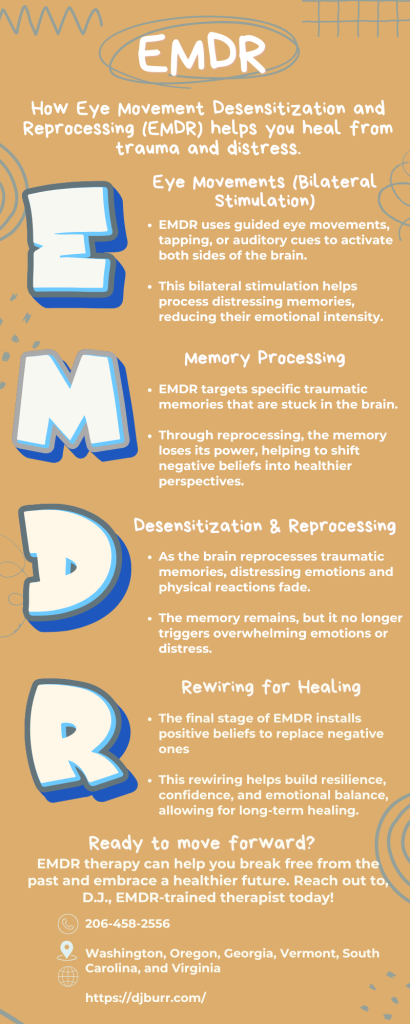
EMDR offers a means to address concerns without delving into explicit details about your experiences.
Frequently, tangible results can be achieved more quickly compared to other therapeutic approaches.
Controlled trials and research studies have indicated the effectiveness of EMDR in mitigating the impact of trauma.
EMDR offers immediate, tangible results within the sessions themselves, eliminating the need for outside efforts like journaling or assignments between appointments.
EMDR has its limitations, mainly that it is particularly effective in cases where the difficulties stem from traumatic experiences. When issues stem from other causes, effectiveness is less conclusive.
Reach out today
D.J. Burr at ABLE Life Recovery helps people overcome their addictions, rebuild their families, and stay sober. address their trauma, and stay sober. By addressing your trauma, D.J. can help you work through the pain to heal. Don’t wait; reach out to a D.J. Burr at ABLE Life Recovery today.
DJ is licensed in Washington, Georgia, Vermont, Virginia, South Carolina, and Oregon.